

Your Lyme Test Came Back Negative. That Doesn't Mean You're Fine.
By Caroline Hoeffgen, COO, BCHC, JD | Reviewed by Dr. Rev. Isabel Sharkar, NMD | Published Apr 2026 | Last reviewed Jul 2026
A negative Lyme test does not rule out Lyme disease. Standard two-tier testing detected only 22 to 36 percent of early infections in a 2025 study, misses co-infections entirely, and can stay negative after early antibiotics. If symptoms persist, a negative result is a reason to look wider, not to stop.
A standard Lyme test never looks for Lyme itself. It looks for your immune system's response to the bacteria, and that response can be slow to build, weak, or missing entirely. When it is, the result reads negative even when the infection is real.
In a 2025 study in the Journal of Clinical Microbiology (https://doi.org/10.1128/jcm.01187-25), standard two-tier testing caught only 22 to 36 percent of early Lyme cases. It also does not test for co-infections at all. And once early antibiotics blunt the immune response, it can stay negative for good.
A negative result is a snapshot of one test, on one day, looking for one thing. It is not a clean bill of health.
Key Takeaways
- Standard two-tier testing caught only 22 to 36 percent of early Lyme infections in a 2025 study. A negative result in the first weeks after a bite is not a reliable answer.
- Early antibiotics can keep the test negative for good. In one study, about 4 in 10 people with a doctor-diagnosed Lyme rash never developed a positive blood test, even after treatment.
- The first screening step is a gatekeeper. If the initial ELISA is negative, the confirmatory test is never run.
- A standard Lyme panel does not test for co-infections. Babesia, Anaplasma, and Ehrlichia each need their own test, and Bartonella is missed too.
- More sensitive testing exists. A negative standard test is a reason to widen the search, not to close it.
Why does a Lyme test miss the infection when it's really there?
In the first weeks after a bite, the antibodies the test looks for may not exist yet. IgM antibodies usually peak three to six weeks after infection, and IgG can take even longer. In the same 2025 study, testing blood again weeks later did not improve detection much.
The bigger blind spot is what happens after early antibiotics. Even a short course early on can blunt the immune response before it builds a detectable level. In one study of people with a doctor-diagnosed Lyme rash (https://pubmed.ncbi.nlm.nih.gov/24924604/), 39 percent stayed negative both before and after treatment. Their blood test can read negative for good, whether or not the infection cleared. A negative test after treatment does not confirm a cure. We go deeper on that in our guide to why Lyme symptoms can persist after treatment (https://www.indigohealthclinic.com/post/examining-lyme-disease-long-term-symptoms). Later in the disease, testing is more accurate for most people, though still imperfect. A negative result that clashes with a strong clinical picture is worth a closer look.
What happens when the first Lyme test comes back negative?
A negative screening test ends the process before the second test ever runs. Standard testing works in two steps (https://www.cdc.gov/lyme/diagnosis-testing/index.html). A screening test called an ELISA goes first. Only if it comes back positive or borderline does the lab run the confirmatory test, the Western blot. A negative ELISA stops the sequence, so the more detailed test never happens. For someone tested too early, or whose response was blunted by antibiotics, the workup can end before it truly begins. A lab number alone is never the whole picture. Symptoms, exposure history, geography, and timing all belong in the same conversation as the result.
-400x396.jpg)
Does a standard Lyme test check for co-infections?
At least four other infections cause symptoms that overlap with Lyme. A standard panel tests for none of them, because it looks only for Lyme itself. Babesia is a malaria-like parasite spread by the same tick that carries Lyme. It needs antiparasitic treatment, not the usual antibiotics. Anaplasma and Ehrlichia are bacterial infections that affect white blood cells. They are usually caught with a PCR test, not a Lyme test.
Bartonella is often called a Lyme co-infection, but it is not an established tick-borne infection in the medical literature (https://doi.org/10.3201/eid1603.090443). Its documented routes are cat scratches and bites, flea exposure, and body lice. It can still cause the cognitive and mood changes people link to tick-borne illness. A standard panel will not detect it either. So it belongs in a thorough workup, even when a tick was not how it arrived. A patient can carry any of these, with or without Lyme, and still return a completely negative standard panel.

How high is the tick-borne illness risk in the DC area?
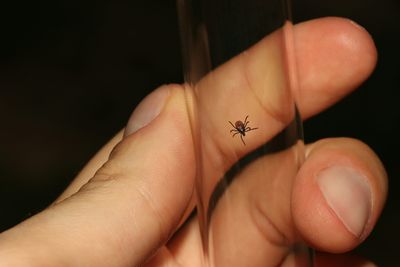
The DC region ranks among the highest-risk areas for Lyme disease in the country. The tick that carries it can be the size of a poppy seed, and most people never see the one that bit them. Under the CDC's surveillance criteria, the District, Maryland, and Virginia all sit in the high-incidence tier. Nationwide, an estimated 476,000 people are diagnosed and treated for Lyme each year (https://doi.org/10.3201/eid2702.202731). In a high-burden region, one negative test read on its own is not a complete evaluation.
What does a negative Lyme test confirm?
A negative Lyme test confirms one thing: on the day of the test, your blood did not show enough Lyme antibodies to cross the reporting threshold. It cannot tell you Lyme is impossible, and it does not rule out a co-infection or confirm that earlier treatment worked. A negative result is a starting point, not a verdict. Sometimes the answer is a co-infection a standard panel skipped. Other times it is a different condition altogether. Many illnesses share these symptoms, and a good workup checks for them too.
Is the standard Lyme test the only option?
The standard blood test is the most common Lyme test, not the most sensitive one. More sensitive testing exists, and it falls into three types.
More detailed antibody tests read more markers than the standard test. Because they look at more of the immune response, they can catch cases the standard test misses.
T-cell tests check a different part of the immune system, one that reacts earlier than antibodies. That means they can flag an infection before antibodies have had time to build.
Direct-detection tests look for the bacteria's own DNA instead of your immune response. They are the only kind that can point to an active infection rather than past exposure.
In our practice, we use more sensitive testing when the standard result does not fit the clinical picture.
Newer versions of all three are in clinical trials right now. Larger diagnostic companies are building them for FDA clearance and insurance coverage. None is available yet. We use the more sensitive testing that exists today, and we will add the newer tests when the evidence supports them.

A Lyme Test Is Not a Diagnosis
A Lyme test is one tool, and the case definition behind it was never meant to diagnose anyone. The surveillance definition exists to count cases for public health, and the CDC states plainly that it is not intended for clinical diagnosis. A skilled clinician weighs the test alongside your history, your exposure, your symptoms, and their timing. In our practice, we regularly see patients whose negative Lyme test was not the whole story. We also see patients whose real answer turned out to be a different condition entirely. If you have persistent symptoms, possible tick exposure, and a negative result that does not fit, that gap is worth pursuing.
A complimentary Discovery Call is where every Indigo patient starts. It is a 20-minute phone call, and a team member walks through your symptom history, your past testing, and what you have already tried. You come away with a clear read on whether your case is one we can help with, and what a fuller workup would look for. No cost, no commitment, just a straight answer on whether this is worth pursuing.
Medical Disclaimer
This content is provided by Indigo Integrative Health Clinic for educational purposes only. It does not constitute medical advice, a diagnosis, or a treatment recommendation, and does not establish a provider-patient relationship. Individual health conditions vary — information presented here may not apply to your specific situation. Always consult a qualified, licensed healthcare provider before making decisions about your health, medications, supplements, or treatment plan.






Continue reading
Climate Change & Lyme Disease
As the global conversation about climate change intensifies, its impact...
Lyme & Tick-Borne Illness

Lyme Disease Is in Rock Creek Park, Northern Virginia, Maryland, and DC. All Are on the CDC's High-Incidence List
The CDC classifies Washington DC, Maryland, and Virginia as high-incidence areas for Lyme. Standard two-tier blood testing catches only 22 to 36 percent of early infections, so a negative result does not rule Lyme out when symptoms are present. Free state and county programs identify a tick's species but do not test it for disease, and broader co-infection testing is not routinely ordered.
Lyme & Tick-Borne Illness

Babesia: The Lyme Co-Infection Your Treatment May Have Missed
Babesia is a malaria-like parasite carried by the same tick that carries Lyme. Because it is a parasite and not a bacterium, the antibiotics typically used for Lyme have no effect on it. It is seldom tested for, so people can finish Lyme treatment, still feel sick, and not understand why.
Lyme & Tick-Borne Illness